Guide
Pentest risk acceptance: how to record a finding you will not fix
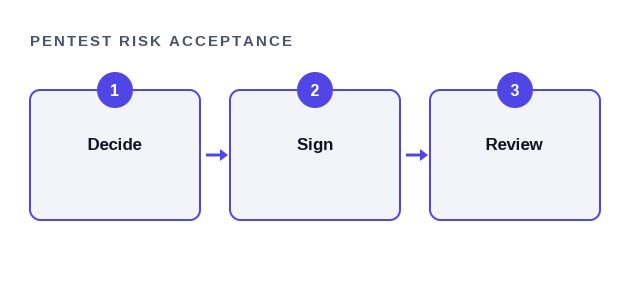
Pentest risk acceptance is a formal decision to keep a finding open. It is legitimate, but only when it is written down, signed by the right person and reviewed again later.
- Fixed fee before we start
- Named tester in writing
- Retest and attestation letter
When pentest risk acceptance makes sense
Not every finding is worth fixing. For example, a low finding on a system due for retirement, or a fix that would break a customer integration. In these cases, accepting the risk can be reasonable.
However, the decision belongs to the business, not the tester. So it needs an owner with authority over the system.
What the record should contain
A good record is short. It names the finding, the reason, the owner, any compensating measure and a review date. Then it is signed.
In addition, link it to the report reference. Because auditors trace findings, the link saves a follow-up request.
| Field | Example |
|---|---|
| Finding | Report reference and title |
| Reason | Why it will not be fixed now |
| Owner | Named person with authority |
| Other measures | What reduces the risk meanwhile |
| Review date | When the decision is checked again |
| Signature | Owner and security lead |
Pentest risk acceptance check
Tick what your process already has.
Your result appears here as you tick, so you can see what is still open.
Who signs pentest risk acceptance
Usually the system owner signs, with the security lead as a second signature. For higher severities, many companies require a senior leader as well.
Also set limits in policy. For example, critical findings cannot be accepted without leadership approval. Then decisions stay consistent.
How auditors read accepted risks
Auditors do not expect zero open findings. However, they expect each open finding to be fixed, planned or formally accepted. An unexplained open finding raises questions.
So a clean risk register is often as useful as a long list of fixes. It shows that decisions were made deliberately.
Reviewing pentest risk acceptance
Accepted risks should not stay accepted forever. Set a review date, often at the next test. Then check whether the reason still holds.
In addition, tell the tester about accepted findings before the next engagement. They can then note whether anything changed.
How Thornbury helps
Every report gives each finding a severity and a recommended fix, so your team can decide what to fix and what to accept. The retest letter then records the status. Packages start at $5,900 for one asset and $14,500 for up to three, and $29,000 covers a broader scope with two retests inside 60 days. Each includes a named tester in writing, a report within 10 working days, an attestation letter and a retest. Testing is delivered by vetted third-party practitioners, and method references include NIST SP 800-115.
Pentest risk acceptance questions
Is pentest risk acceptance acceptable to auditors?
Yes, when it is documented, signed and reviewed.
Who should approve pentest risk acceptance?
The system owner, usually with the security lead and, for high severities, a senior leader.
How long can a risk stay accepted?
Until its review date, often the next test cycle.
Does the retest cover accepted findings?
It records their status as accepted rather than closed.
Related guides
Plan pentest risk acceptance before the report arrives
Send your brief through the form on our home page. We reply with a fixed fee and a proposed window.
Get my fixed-fee quote